Use your keyboard arrow keys — or swipe a direction on a touchscreen — to move. Your objective is to push each box into a slot.
Use your keyboard arrow keys — or swipe a direction on a touchscreen — to move. Your objective is to push each box into a slot.
Muse is a logic puzzle game created for Windows 3.11 in 1994 by Jeffrey Baker and Perry Glover, inspired by Sokoban: push every block onto a slot, one at a time and never pulling, in the fewest moves. In 2026 the original game and its preserved levels were reconstructed using AI and modern development tools by 3ring, LLC.
In 1994, Jeffrey Baker and Perry Glover created a PC puzzle game called Muse in Richmond, Virginia. At the time, Jeff and Perry were programmers working together at Performance Food Group.
Muse was inspired by Sokoban, the Japanese box-pushing puzzle created by Hiroyuki Imabayashi (今林宏行) in 1981. We took that basic idea and built our own game around it.
We developed Muse for Windows 3.11, and that is where it stayed. For more than 30 years, we never converted it to run on modern versions of Windows.
Until now.
Muse had something we didn’t want to lose: a collection of amazing puzzle levels, many of them created by players from around the world.
Push every block onto a slot.
You can push blocks, but you can never pull them, and you can only push one block at a time. That sounds easy.
It isn’t. Push a block into the wrong corner and it may be stuck there permanently, so some levels have to be thought several moves ahead before you touch a single block.
The rules in full, with the pieces and the traps →
Fewest moves wins.
Same number of moves, and the faster time ranks higher; identical on both, and whoever got there first keeps the higher position. The clock starts on your first move, not when the level loads, so studying the board costs you nothing.
And there is another reason to keep playing:
Muse tracks world records for every level.
Solve a puzzle in fewer moves—or beat the fastest time—and put your name on the board.
We had preserved scans and printouts of the original levels. Rather than rebuild every board by hand, square by square, we taught an AI the rules of Muse—how the player moves, how blocks move, how slots and transports work—and the size, spacing and coordinates of a Muse board.
It could then read a scan of an original level and work out where the walls, blocks, slots, transports and the player belonged, and those positions became the level data the new game loads. Every recovered level is checked by a solver before it ships.
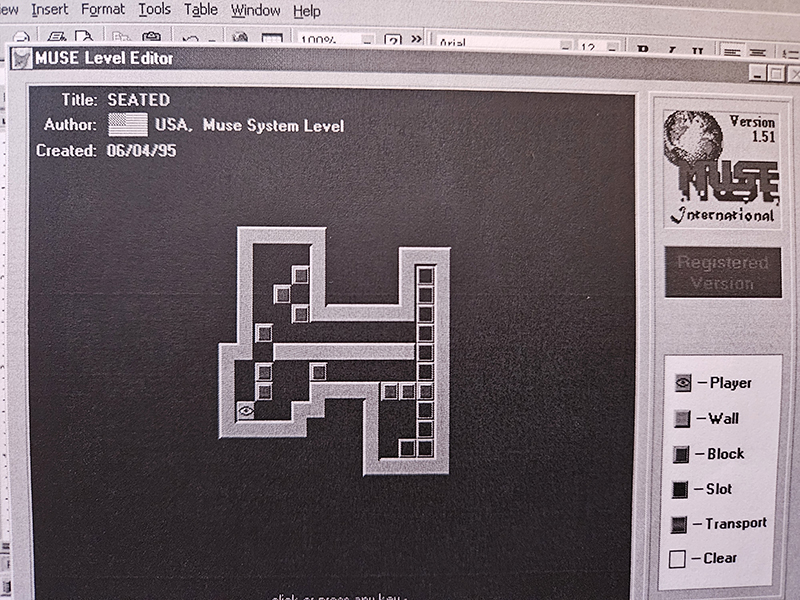
In a way, we used today’s technology to recover software created more than three decades ago—and to preserve the work of the players who made many of these puzzles.
How the restoration worked, step by step →
Reading the old levels taught the AI a great deal about how a Muse puzzle is put together, so we went further and trained it to design them. We named him CLAUDEus Caesar: the AI level designer that creates new Muse puzzles from the patterns and rules it learned in the originals.
His levels carry his name where the others carry their author’s, and a sparkle where those carry a flag—so you always know which is which. Every one is checked by machine before it ships: solvable, and solvable the hard way.
Found a bug, have a level you would like to see, or just want to say hello? We would love to hear from you.
Not set yet — nobody has solved this level.
Just once, so the high score tables stay honest.